01/01/26
9 min
A Guide to Oregon Automobile Insurance Requirements in 2026

Table of Contents
Justice Simplified
Oregon Automobile Insurance Requirements
Auto insurance acts as an invaluable safety net for Oregon drivers, whether you drive a minivan, a motorcycle, or a cargo truck, stepping in to help shoulder the financial risk all drivers bear. But in the state of Oregon, as in most U.S. states, keeping car insurance is more than just a good idea—it’s the law. Oregon’s automobile insurance requirements outline which types of insurance drivers are required to maintain, as well as the exact minimum coverage amounts.
These requirements help keep Oregon drivers safe, but they can also be a source of anxiety. Driving without meeting Oregon’s car insurance requirements is considered a Class B traffic violation, and can result in a fine of up to $1,000.
It’s extremely important to understand the minimum insurance amounts imposed by Oregon law, not only to ensure compliance, but so that you know what to expect in the event of an accident. That’s why, in this blog, we’re going to quickly unpack the ins and outs of Oregon’s automobile insurance requirements, including special considerations for commercial vehicle operators and rideshare drivers. For a full summary, refer to the table at the end of this blog.
What Car Insurance Is Required in Oregon?
Oregon requires the following types of car insurance for all drivers:
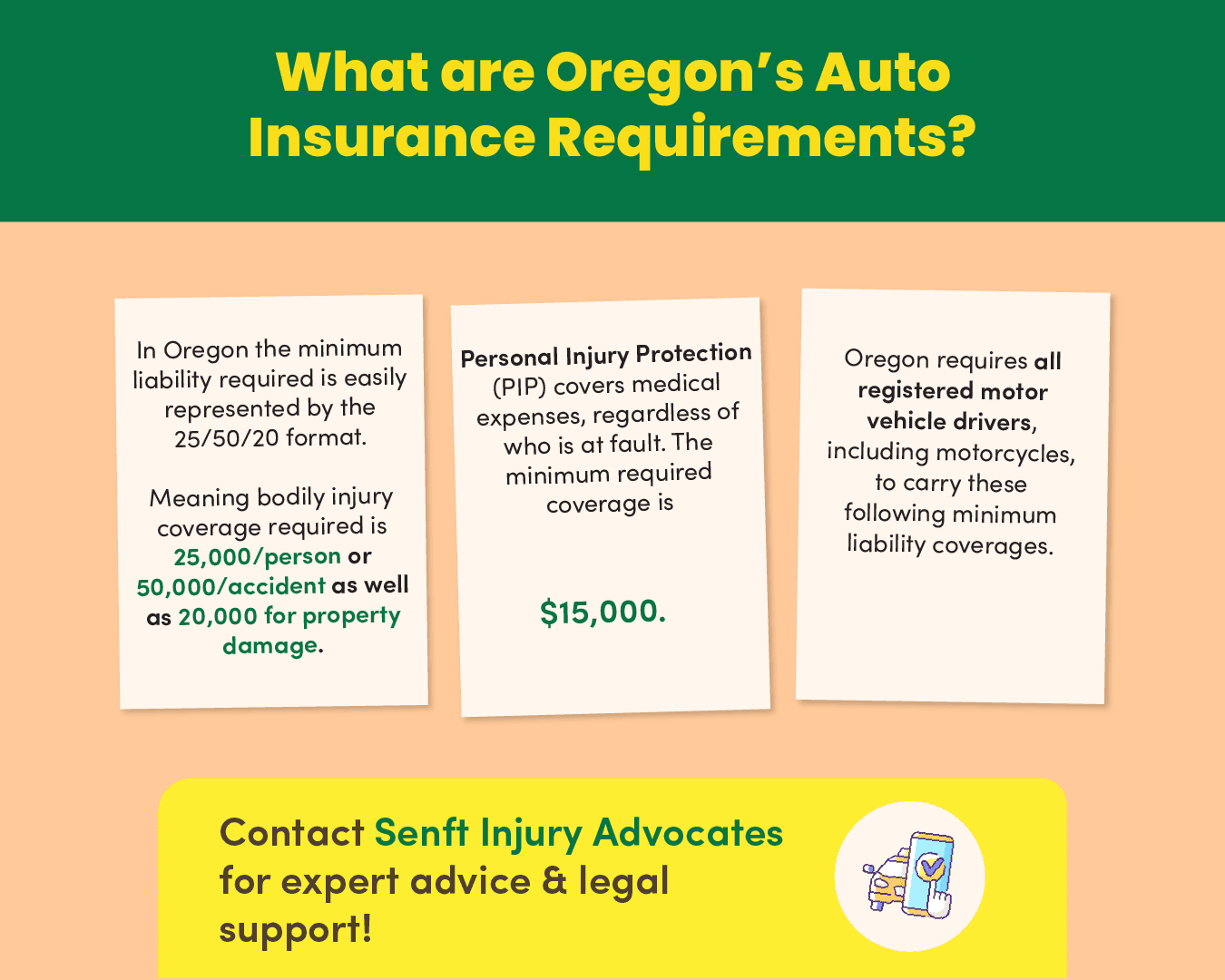
- Bodily Injury Liability Insurance, which covers injury you cause to other persons in an accident. The minimum amount required is $25,000 per person, and not less than $50,000 per accident.
- Property Damage Liability, which covers damage you cause to others' property in an accident. The minimum amount required is $20,000 per accident.
- Personal Injury Protection (PIP), which covers injury to you and your passengers, regardless of who caused the accident. The minimum amount required is $15,000 per person.
- Uninsured Motorist (UM) Coverage, which covers damage caused to you by a driver who doesn't have any insurance (or, in some cases, after an Oregon hit and run). The minimum amount required is $25,000 per person and $50,000 per accident, both for bodily injury.
The amounts listed above constitute the minimum Oregon car insurance requirements in 2026. However, some motorists choose to purchase insurance with higher limits for stronger protection against severe accidents.
Additional Types of Automobile Insurance in Oregon
There are also additional types of insurance you can purchase, which provide further protection. These are not generally required by Oregon law, but may help cover situations which aren’t already covered by the minimum auto insurance. Here are a few examples:
- Collision Coverage, which covers damage caused to your vehicle by colliding with inanimate objects, such as telephone poles, potholes, and fire hydrants.
- Comprehensive Coverage, which covers damage caused to your vehicle due to situations other than standard crashes. This includes natural disasters such as earthquakes or flooding, hitting an animal on the road, vandalism or theft, and more.
- Umbrella Policies, a special kind of insurance that only kicks in if your other insurance isn't enough to pay for the damages you've incurred.
Additional Requirements for Certain Drivers
The minimums we have already listed serve as a general rule for most Oregon drivers, but there are certain additional requirements which apply situationally. For instance, large trucks hauling cargo carry a potential for greater financial loss, and are thus subject to stricter insurance regulations.
It’s important to understand these requirements, no matter what kind of vehicle you drive. First and foremost, it’s absolutely crucial to make sure you’re not underinsured by Oregon’s standards. But even if none of the below requirements apply to you, they can be valuable to know in the event of an accident with such drivers, so you can know what to expect if you need to make a claim against their insurance.
Federal Requirements for Commercial Vehicle Drivers
Commercial vehicle operators in Oregon are subject to the same insurance requirements as other drivers. However, they may need additional coverage based on their usage.
The Federal Motor Carrier Safety Administration (FMCSA) sets forth specific requirements that supplement state laws. This insurance covers medical treatment and repair costs for victims if a truck driver causes an accident.
According to the FMCSA, freight forwarders and motor carriers who transport household goods must have cargo insurance, at a minimum of $5,000 per vehicle and $10,000 per incident. Additionally, freight brokers and forwarders must secure at least $75,000 in trust fund agreements or surety bonds.
Commodity-Specific Requirements
The FMCSA also enforces commodity-specific financial responsibility requirements, which vary based on the nature of the cargo:
- $300,000 for transporting household goods
- $750,000 for general cargo
- $1,000,000 for oil transport
- $5,000,000 for hazardous materials transport
Rideshare Insurance Requirements in Oregon
For rideshare drivers in Oregon, understanding insurance requirements can be especially tricky, but it is crucial nonetheless. While not logged into the app and driving for the company, rideshare drivers are protected by their own automobile insurance. However, when they are actively working as a rideshare driver, the company is required to keep certain insurance.
When Not Engaged in a Ride (app on, but no ride accepted):
- Bodily Injury Liability: $50,000 per person, $100,000 per accident
- Property Damage: $25,000 per accident
When Engaged in a Ride (from the moment a ride request is accepted to the completion of the ride):
- Combined single limit of $1,000,000 for liability, which encompasses both bodily injury and property damage.
Further Rideshare Insurance Requirements
Oregon also requires rideshare companies to keep a combined single limit of $300,000 for bodily injury and property damage liability for the period after completing a ride if the driver remains connected to the app and available to accept another rider. This limit also applies for up to an hour after the driver has disconnected from the app.
In addition to other requirements, rideshare companies are required to keep personal injury protection and uninsured motorist coverage equal to that which is required of all drivers.
Comprehensive Chart of Oregon Insurance Requirements
Type of Vehicle | Bodily Injury (Per Person / Per Accident) | Property Damage | Death, Bodily Injury, and Property Damage (Combined Single Limit) | Personal Injury Protection | Uninsured Motorist (Bodily Injury) (Per Person / Per Accident) |
|---|---|---|---|---|---|
Auto (Including Motorcycles) | $25,000 / $50,000 | $20,000 | N/A | $15,000 | $25,000 / $50,000 |
Commercial Vehicle* | $25,000 / $50,000 | $20,000 | N/A | $15,000 | $25,000 / $50,000 |
Rideshare (Not Engaged in Ride) | $50,000 / $100,000 | $25,000 | N/A | $15,000 | $25,000 / $50,000 |
Rideshare (Engaged in Ride) | N/A | N/A | $1,000,000 | $15,000 | $25,000 / $50,000 |
*The FMCSA has requirements for commercial vehicles that supplement state law. For more information, refer to the 'Federal Requirements for Commercial Vehicle Drivers' section in the article.
Legal Guidance with Senft Injury Advocates
If you’ve been in an accident and need help understanding how Oregon’s automobile insurance requirements impact your case, don’t hesitate to call Senft Injury Advocates. Offering 24/7 availability and a 100% free consultation, we’re here to help you make sense of your coverage and answer any questions you may have. Our team is ready to guide you through the recovery process, and stand with you to advocate for fair car accident compensation in Oregon.
Sources
- Federal Motor Carrier Safety Administration, "Insurance Filing Requirements"
- House Bill 3379, Oregon Legislative Assembly 2019 Regular Session
- Oregon Department of Transportation, "Insurance Requirements"
- Oregon Revised Statutes 153.018
- Oregon Revised Statutes 806.010
